
Water coming through the ceiling: what to do right now
If water is coming through your ceiling as you read this, do not panic and do not run for a ladder. The order you do things in matters more than speed.
The biggest risks in the first few minutes are not the roof, they are inside: water near electrics, and a ceiling holding a hidden pool that can collapse without warning. Deal with those first, protect your belongings, then get an emergency roofer on the way to stop it at source. Work through the steps below in order.
Do this first, in order
- Switch off the electrics to the affected area at the consumer unit.
- Contain the water with buckets, bins and towels.
- Safely pierce a bulging ceiling to drain it into a bucket.
- Move valuables and cover the floor.
- Take photos and a short video for insurance.
- Call an emergency roofer. Do not climb on the roof.
Step 1: switch off the electrics in that area
Water and wiring do not mix, and this is the one step you should never skip. If water is anywhere near a light fitting, ceiling rose, downlight or socket:
- Go to your consumer unit (fuse box) and switch off the circuit for that part of the house.
- If you are not sure which circuit it is, turn off the main switch and use a torch.
- Do not touch switches or fittings that are wet, and keep everyone clear of dripping light fixtures.
If you can see water pooling inside a light fitting or bulging around a downlight, treat it as live and dangerous until the power is off.
Step 2: contain the water
Once the power is safe, limit where the water goes:
- Put buckets or a bin under the active drips.
- Lay towels or old sheets around them to stop splashing and spreading.
- If the drip is fast, put a smaller container inside a larger one so you can swap it out without stopping the catch.
- Have a second bucket ready, because a leak that starts slow can speed up as more water finds the path.
Step 3: safely drain a bulging ceiling
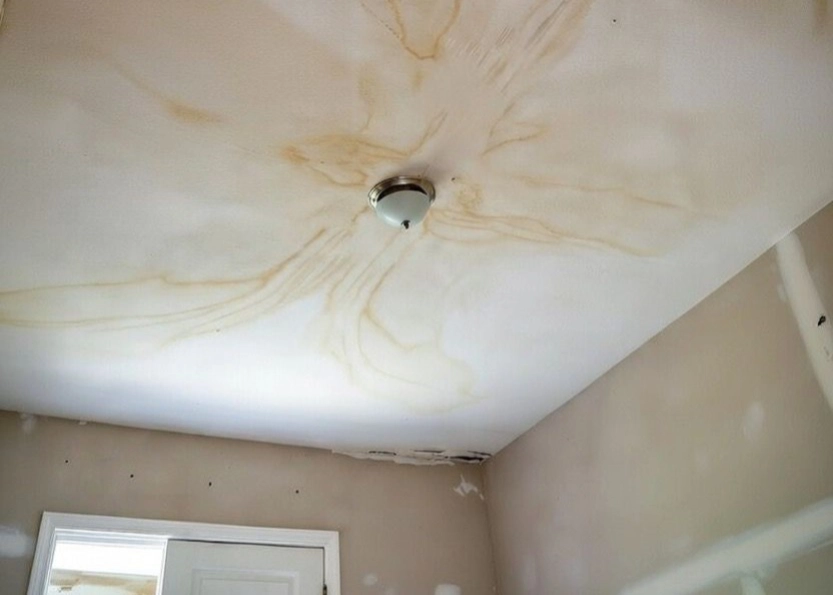
This is the step people are most afraid of, but it is important. If part of the ceiling is sagging or bulging, water is trapped above the plasterboard, and the weight can bring the whole section down suddenly, dumping gallons at once.
To release it in a controlled way:
- Put a bucket directly underneath the lowest point of the bulge.
- Using a screwdriver or similar, make one small hole at the very lowest point.
- Stand to the side, not underneath, and let it drain slowly into the bucket.
It feels wrong to put a hole in your own ceiling, but one controlled drain hole is far better than a surprise collapse. Make one hole, not ten, and let it do the work.
Step 4: move valuables and protect the floor
With the water contained, save what you can:
- Move furniture, electronics and anything of value out of the area.
- Lift rugs and cover carpet with plastic sheeting or a tarp.
- Put important documents and soft furnishings well clear.
Water spreads further than you expect once it hits a floor, so give yourself a wide margin.
Step 5: take photos and video for insurance
Before you clean anything up, record it:
- Photograph the ceiling stain, the dripping, and any damaged belongings.
- Take a short video showing the water actually coming through.
- If you can do it safely from the ground, photograph any obvious roof or gutter damage outside.
Most home insurance covers sudden and accidental damage, and clear evidence makes any claim far smoother. Get the leak stopped first, though, because insurers expect you to prevent further damage. If you are unsure who handles what, our guide on who to call for a ceiling leak covers roofer, plumber and insurer.
Step 6: call an emergency roofer
Once the inside is safe and contained, get the source stopped. A slipped tile, a failed flashing joint or a blocked gutter overflowing will keep letting water in until it is properly dealt with, and every hour of active leaking adds to the damage below.
Alliance Roofing & Building offers a same-day response for active leaks, with no call-out charge, £1m public liability cover, and every repair backed by our 10-year workmanship guarantee. When you call, tell us your postcode, when the leak started, and whether it tracks with the rain, and we will get to you fast. See our emergency roof repair service for how it works.
What NOT to do
A few "helpful" reactions make things worse:
- Do not climb onto the roof. A wet roof in bad weather is how people get seriously hurt. Leave the outside to a roofer.
- Do not ignore a bulging ceiling. Trapped water gets heavier and collapses without warning. Drain it into a bucket as above.
- Do not switch wet lights or sockets back on until an electrician or roofer has confirmed the area is dry and safe.
- Do not smear sealant everywhere. Guesswork "repairs" can trap water in the wrong place and make the real fix harder.
- Do not just paint over the stain later. That hides the problem and traps moisture.
Why the water is coming through
Once the emergency is under control, it helps to understand the cause. Water rarely enters where the stain appears. It gets in through the roof covering or a failed detail, runs along the rafters, soaks the insulation, then breaks through the ceiling at the weakest point, often several feet from the actual entry.
The usual culprits are slipped or cracked tiles, failed flashing around a chimney or wall, a blocked gutter overflowing back into the roof, or a worn valley. Our pillar guide on water leaking through the ceiling after rain walks through each cause in detail. If the ceiling is leaking when it has not rained, the problem is more likely internal, and our guide on a ceiling leaking but no rain explains why.
After the emergency
Once the roof is stopped, the inside still needs attention. The area that got wet will need drying, sometimes for days, and damaged plasterboard may need replacing and repainting with a stain-blocking primer. Soaked loft insulation should be checked, because if it is left in place damp it holds moisture and can lead to mould. For a plain-English breakdown of what the whole repair tends to cost, see our guide on the cost to fix a ceiling leak from the roof.
Get an emergency roofer out today
If water is coming through your ceiling right now, make the inside safe using the steps above, then call us. We will get the source found and stopped, explain what failed in plain English, and put it right so it does not keep coming back.
Same-day response, no call-out charge, fully insured, 9.96/10 on Checkatrade from 103 reviews, and all work guaranteed for 10 years. We cover homes across Buckinghamshire, Berkshire and the wider South East. Call now or send photos through the form below.