
If you search “what is the best material for a flat roof”, you’ll get a mess of opinions, product marketing, and outdated advice. The problem is that there isn’t one single “best” flat roofing material for every job. If you want a straight recommendation for your property, our flat roofing specialists will tell you which system actually suits it.
The best flat roof material depends on:
- The type of building
- How long you want it to last
- How quickly it needs installing
- Whether it’s DIY or trade-installed
- Budget vs long-term reliability
- UK weather exposure
This guide breaks it down properly, using materials we actually work with on domestic extensions, garages, dormers, and repairs across the UK.
Key takeaways
- There is no single best flat roof material. The right one depends on the building, budget, lifespan and installer skill.
- For UK homes, EPDM rubber is the most reliable and forgiving all-rounder. GRP fibreglass gives the best rigid finish.
- Liquid systems suit awkward shapes, repairs and overlays. Torch-on felt still works in skilled hands.
- Most flat roof failures come from poor detailing at edges and outlets, not bad materials.
What materials are best to use for flat roof systems in the UK?
In the UK, modern flat roofs are usually built using single-ply or cold-applied systems, not old-style felt alone.
The main flat roof materials you should be comparing today are:
- EPDM rubber
- GRP fibreglass
- Torch-on felt systems (multi-layer)
- Cold-applied felt systems
- Single-ply membranes (PVC, TPO)
- Liquid-applied systems (for repairs and detailing)
Each has strengths and weaknesses. Anyone telling you one product is always “the best” is either selling it or hasn’t worked with the others.
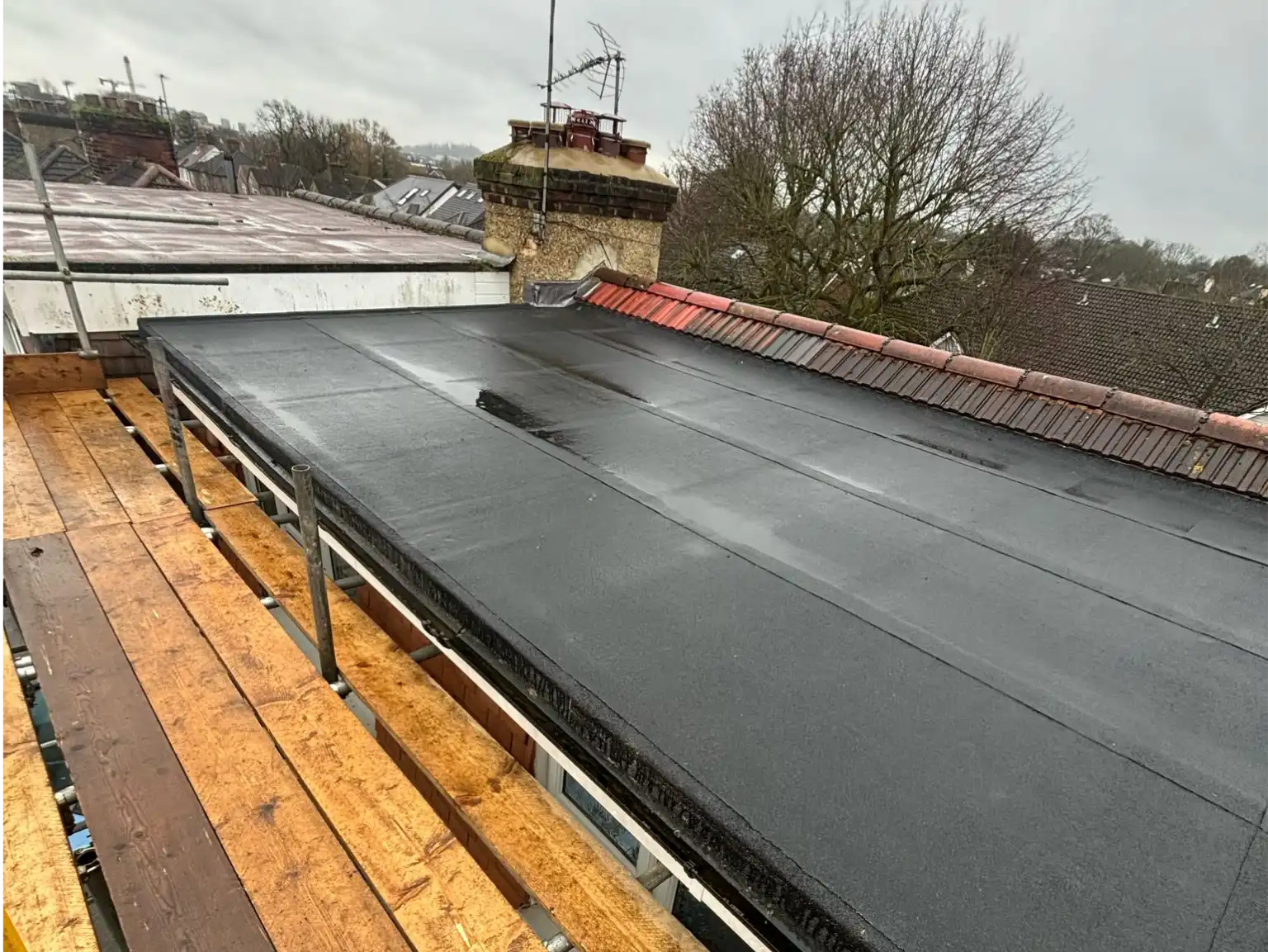
Flat roof materials compared: pros, cons and who each one suits
Before the detail, here is how the five main UK flat roofing systems stack up against each other.
| Material | Best suited to | Main strength | Watch out for |
|---|---|---|---|
| EPDM rubber | Extensions, garages, dormers, workshops, larger flat areas | Few joints, handles building movement and temperature change well | Functional black finish, can be punctured by sharp objects |
| GRP fibreglass | Smaller and more visible roofs, bay roofs, porches, dormers, balconies | Seamless, rigid, smart finish | Rigid, so it can crack if the deck moves, and it needs dry install conditions |
| Torch-on felt | Garages, sheds, outbuildings and simple small roofs on a tight budget | Lowest upfront cost, quick to fit on simple shapes | Shortest lifespan, looks patchy after repeated repairs, dislikes foot traffic |
| Single-ply (PVC, TPO) | Larger or more complex roofs, commercial buildings, high-spec projects | Wide sheets, heat-welded seams, lightweight | Needs trained installers and welding equipment, repairs are not a DIY job |
| Liquid-applied | Awkward shapes, roofs with lots of penetrations, overlays and repairs | Seamless finish that copes with difficult detailing | Performance depends heavily on surface preparation |
Lifespan is the other half of the comparison, and it swings far more on drainage and workmanship than most product brochures admit. We break the numbers down system by system in our guide to how long a flat roof lasts.
Torch-on felt (modified bitumen)
Torch-on felt is still one of the most common systems on garages, extensions and porches. It is built from multiple layers of bitumen felt heated and bonded together with a gas torch.
Pros: lower upfront cost than most modern systems, fast on simple shapes, easy to patch repair in the short term, and modern high-performance felts perform far better than the 1960s and 70s felt people remember.
Cons: a typical lifespan of 10 to 15 years for standard felt, longer for high-performance systems. It looks tired and patchy after repeated repairs, it does not like heavy foot traffic, and heat-based installation is not ideal in tight or sensitive areas.
Best for: homeowners who need a budget-friendly option on a simple, small flat roof and accept they are trading lower cost now for a shorter lifespan.
EPDM rubber
EPDM is a synthetic rubber membrane rolled out in large sheets and bonded down. Because it can often cover a roof in one piece, there are fewer seams and fewer places for a leak to start.
Pros: long lifespan, few seams, and it handles movement and temperature swings without cracking. Low maintenance, and usually easier to repair than rigid systems.
Cons: the finish is functional rather than decorative, it is essentially a large black rubber sheet. It can be pierced by sharp objects, tools or broken branches if the membrane is not thick enough, and poor installation quickly shows up as bubbling, loose edges and ponding.
Best for: homeowners who want a long-lasting, low-maintenance roof and are not bothered about looking down on a black surface.
GRP fibreglass
GRP, or glass reinforced plastic, is built on site from resin and fibreglass matting and finished with a topcoat. Once cured it forms a hard, seamless waterproof shell over the deck.
Pros: very strong and rigid, seamless across the main field of the roof, available in different colours for a clean modern look, and small repairs blend in neatly when handled by a professional. It suits balconies, terraces and areas with light foot traffic.
Cons: usually more expensive upfront than felt or basic EPDM, sensitive to weather during installation, and less suitable for very large roofs on a tight budget. Poor installation leads to cracking, pinholes and early failure.
Best for: homeowners who want a smart, clean-looking flat roof and are willing to invest more for the finish.
Single-ply membranes (PVC and TPO)
PVC and TPO are flexible plastic single-ply membranes used widely on commercial buildings and larger flat roofs, and increasingly on high-spec residential projects.
Pros: lightweight where extra load is a concern, supplied in wide sheets so there are fewer seams, heat-welded at the joints for strong and consistent seams, good fire and UV resistance in many systems, and available in light colours that reflect heat.
Cons: installation needs trained installers and proper welding equipment. Some systems are less forgiving if the deck is not perfect, poor detailing around corners, vents and upstands undoes the benefits, and repairs need matching materials rather than a DIY patch.
Best for: larger or more complex flat roofs where weight, energy performance and professional installation are the priorities. TPO in particular is less common on UK domestic roofs, so there are fewer specialist installers, which affects both price and availability.
Liquid-applied systems
Liquid systems go on like a thick paint and cure into a seamless waterproof layer. On a suitable substrate they can be applied over certain existing roofs.
Pros: excellent on awkward shapes, roofs with lots of penetrations, and complicated detailing. Often installable over an existing roof, avoiding a full strip in some cases, and some systems are reinforced with fabric for extra strength.
Cons: performance depends heavily on surface preparation, cheaper coatings can fail quickly, and weather and temperature affect curing. Not the right answer for a totally failed roof that needs a full rebuild.
Best for: roofs with complex details, or specialist overlays where a full replacement is not yet needed but a quick coating slapped on top is not good enough.
What is the best flat roof material for long-term reliability?
If longevity is the priority, these are the strongest performers when installed correctly:
EPDM Rubber
- Proven lifespan of 30–50 years
- Highly resistant to UV and standing water
- Fewer joints means fewer failure points
- Excellent for domestic flat roofs
EPDM is one of the most reliable flat roofing materials available in the UK when fitted properly.
GRP Fibreglass
- Seamless, rigid finish
- Long lifespan if installed perfectly
- Excellent waterproofing
GRP lasts well, but installation quality matters more than the product itself. Poor detailing leads to cracking.
Multi-layer Torch-On Felt (3-layer systems)
- Still reliable when installed by experienced roofers
- Good lifespan if maintained
- Better than older felt systems
Torch-on felt works, but requires heat, skill, and proper falls.
Verdict: For long-term reliability on domestic roofs, EPDM and GRP lead the pack.
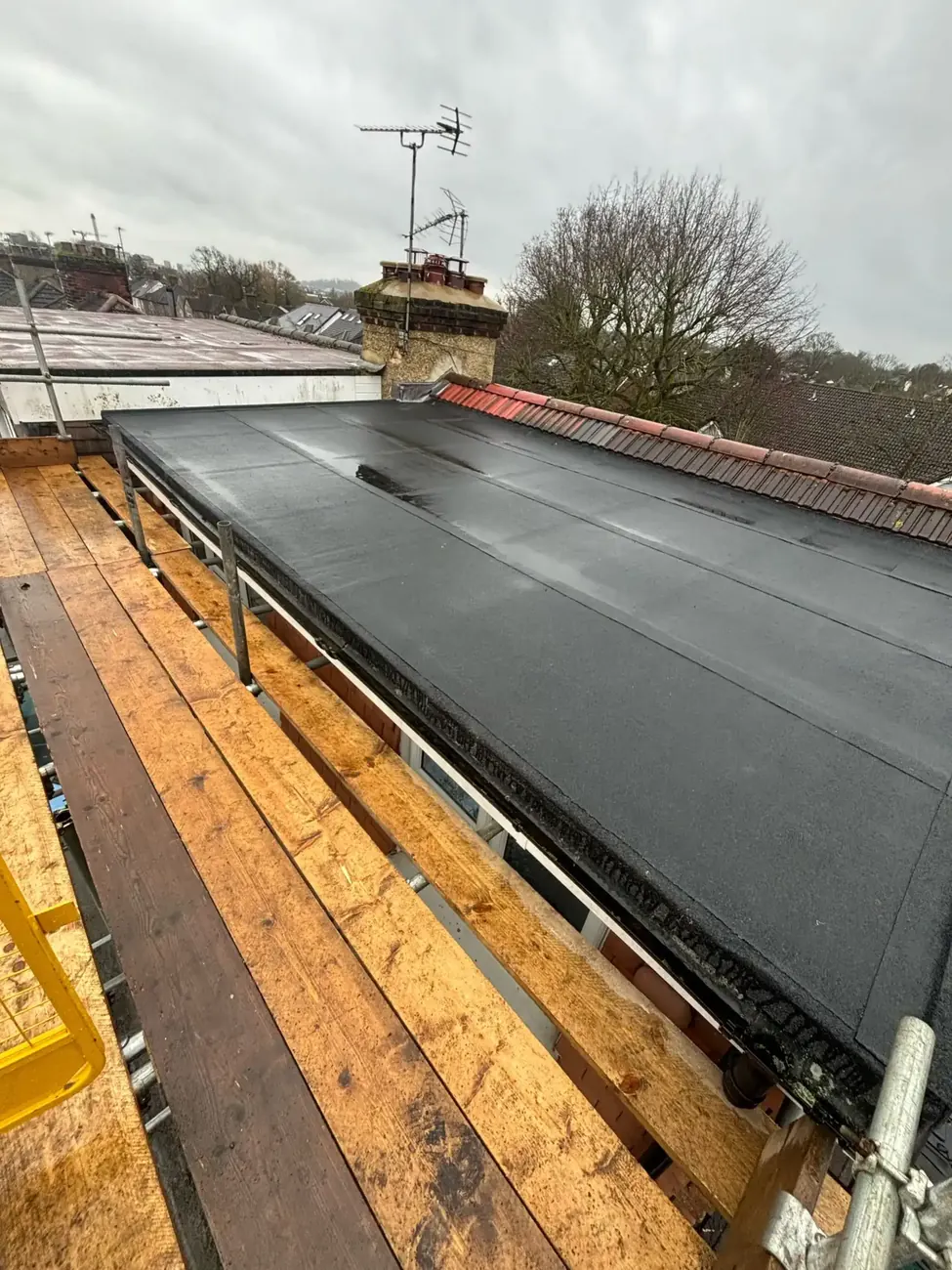
What is the best flat roof material in the UK for small extensions?
For rear extensions and small domestic flat roofs, builders and roofers most commonly choose:
EPDM Rubber (Most popular)
- Fast installation
- No flame
- Ideal for small to medium roof areas
- Easy to detail around edges and outlets
GRP Fibreglass (Popular with experienced installers)
- Clean finish
- Works well where access is good
- Strong aesthetic appeal
What’s the most popular flat roofing product for builders doing small extensions? EPDM rubber is currently the most common choice due to speed, safety, and durability.
Best flat roof material by job type
The same question gets a different answer depending on what is underneath. These are the choices we make most often on real jobs.
Best flat roof material for a garage
For a garage, EPDM or felt are the usual choices. Felt does the job if you want something affordable and functional. EPDM is the better long-term option if you want a longer-lasting upgrade with less maintenance.
Best flat roof material for a dormer, bay or small roof area
GRP is very popular on smaller roofs like dormers because of the neat, seamless finish. These roofs also tend to be more visible from the ground or from upstairs windows, so appearance carries more weight than it does on a garage roof.
Best flat roof material if you want the lowest maintenance
EPDM is usually the safest answer. It performs well, handles movement better than rigid systems, and does not normally need much attention once it is installed properly.
Best flat roof material if the budget is tight
Felt still has a place. It is not the strongest long-term performer of the main options, but on the right job it is a sensible, cost-effective choice, and it is straightforward to patch if a small issue appears later.
What flat roofing products offer the best value for trade customers on short jobs?
On short jobs, value is about time, reliability, and reduced risk, not just material cost.
Best value options:
- EPDM kits (pre-cut membranes)
- Cold-applied felt systems
- Liquid systems for repairs or overlays
EPDM offers:
- Minimal labour
- No curing delays
- Fewer call-backs
That’s why it’s widely used by builders working on tight schedules.
What flat roof materials are best for quick installation and long-term durability?
If speed and durability both matter:
- EPDM rubber
- Installed in a single sheet
- No drying time
- Long lifespan
- Cold-applied felt systems
- Faster than torch-on
- No fire risk
- Good durability when layered correctly
- Liquid-applied systems
- Ideal for awkward shapes or refurbishments
- Seamless finish
- Depends heavily on prep quality
What are the best DIY flat roof materials that don’t require flame-on work?
For DIYers, flame-on systems are a bad idea unless you’re trained.
Best DIY-friendly options:
- EPDM rubber roofing kits
- Cold-applied felt systems
- Some liquid waterproofing products (small areas only)
EPDM is the safest DIY option if:
- The deck is sound
- Falls are correct
- Edge trims and outlets are installed properly
DIY mistakes usually happen at edges and drainage points, not the membrane itself.
How do I compare flat roofing products properly?
Ignore marketing claims and compare materials on these points:
- Expected lifespan (real-world, not brochure)
- Number of joints
- Resistance to standing water
- Ease of repair
- Installation risk
- Suitability for UK climate
A product isn’t “bad” just because it’s cheaper, and expensive doesn’t mean reliable if installed badly.
Beyond the membrane: what else decides the right system
Material choice is only part of the decision. Four things push homeowners towards one system over another, and they rarely appear in the product literature.
- Budget now versus total cost over time. Cheaper materials usually mean more frequent repairs and an earlier replacement. The cheapest roof on day one is often not the cheapest roof over 20 years.
- How visible the roof is. If you look down on it from a bedroom window, appearance matters more, and that tends to point towards GRP.
- Foot traffic. If the roof gets walked on for access to skylights, plant equipment or a small terrace, it needs a system built to handle that safely, not a basic cover.
- Insulation and energy performance. A proper flat roof should be warm and efficient as well as waterproof. The build-up under the waterproof layer matters as much as the layer on top.
Exposure counts too. If the property sits in an open, windy spot, or is surrounded by trees dropping debris into the outlets, that changes what we recommend. We see it constantly on roofs across Berkshire and the wooded parts of the South East.
What is the best covering for a flat roof overall?
There is no single answer, but in most UK domestic situations:
- Best all-rounder: EPDM rubber
- Best rigid finish: GRP fibreglass
- Best traditional system: 3-layer felt
- Best for awkward shapes or repairs: liquid systems
The best flat roof system is the one that matches the building, budget, and installer skill level.
How to roof a flat roof properly (high-level overview)
Regardless of material, all good flat roofs follow the same rules:
- Correct falls to outlets
- Solid, dry deck
- Proper edge detailing
- Correct drainage
- Correct fixing method for the system used
Most flat roof failures are caused by poor detailing, not bad materials.
What a good roofer should tell you before you commit
A good material installed badly is still a bad roof. Flat roofs fail at joints, upstands, outlets and trims long before the membrane itself gives up, which is why the installer matters as much as the product.
Before you sign anything, the roofer should be able to explain, in plain language:
- why they are recommending that system for your roof
- how it suits the structure, the falls and the way the roof is used
- how long it should realistically last
- what maintenance, if any, it needs
- what guarantee comes with the work
If they cannot answer those clearly, they probably have not thought it through. Anyone quoting for flat roof installation and repair should be checking the deck, the insulation and the drainage, not just pricing a covering by the square metre.
What is the best roofing material for a flat roof?
If you want the blunt answer most homeowners are actually asking:
For UK domestic flat roofs, EPDM rubber is currently the safest, most reliable, and most forgiving option when installed properly.
But if access, finish, or design requires something else, other systems can be just as good.
Final thoughts from real roofing experience
Flat roofing isn’t about finding a “magic product”. It’s about:
- Choosing the right system
- Installing it properly
- Detailing it correctly
- Matching material to use case
We see good materials fail every year because they were rushed, badly detailed, or used in the wrong situation.
If you’re planning a flat roof and want it to last, get advice from people who actually install and repair them, not just sell the materials. We do exactly that for homeowners across Buckinghamshire and the wider South East.