
How much does a new roof cost in the UK? For most homes a full roof replacement costs between £4,000 and £15,000, with London and the South East around 15 to 25 percent higher. Most people reading this have just had a roofer knock on the door, spotted a damp patch on the ceiling, or been quoted a number that made them want to sit down. This guide sets out what a new roof really costs in 2026 by property type, material, roof size and region, the extras most quotes leave out, and how to tell whether you need a full re-roof at all. If the damage is isolated rather than widespread, our roof repair cost guide prices that job instead. When you want a real number for your own roof, our new roof and pitched roofing team gives free, fixed written quotes.
Key takeaways
- A full roof replacement runs roughly £4,000 to £15,000, with London and the South East around 15 to 25 percent higher.
- Material is the biggest cost lever: concrete tiles are cheapest, natural slate and clay cost more but last far longer.
- Roof size and shape come next. A simple gable roof is far cheaper to work on than a hipped roof with dormers, valleys and multiple levels.
- Budget separately for scaffolding, stripping and disposal, and a contingency for structural repairs found once the roof is open.
- Spray foam in the roof must be removed first and changes the scope significantly.
How much does a new roof cost in the UK?
For most homes in the UK, a full roof replacement sits somewhere between £4,000 and £15,000. That range sounds useless, but the gap exists for a reason. A small terraced house in Basingstoke is a very different job to a large detached in Wimbledon. Our wider roofing cost guide shows how prices compare across repairs, flat roofs and full re-roofs if you want the bigger picture.
In London and the South East, expect to pay around 15 to 25 percent more than the national average. Labour costs more here, materials take longer to deliver, and parking a van and scaffold in a residential street adds time to every job.
Here are realistic figures by property type:
| Property type | UK average | London and South East |
|---|---|---|
| Terraced house | £4,000 – £6,000 | £5,000 – £7,500 |
| Semi-detached | £5,500 – £8,000 | £6,500 – £10,000 |
| Detached house | £8,000 – £14,000 | £10,000 – £17,000 |
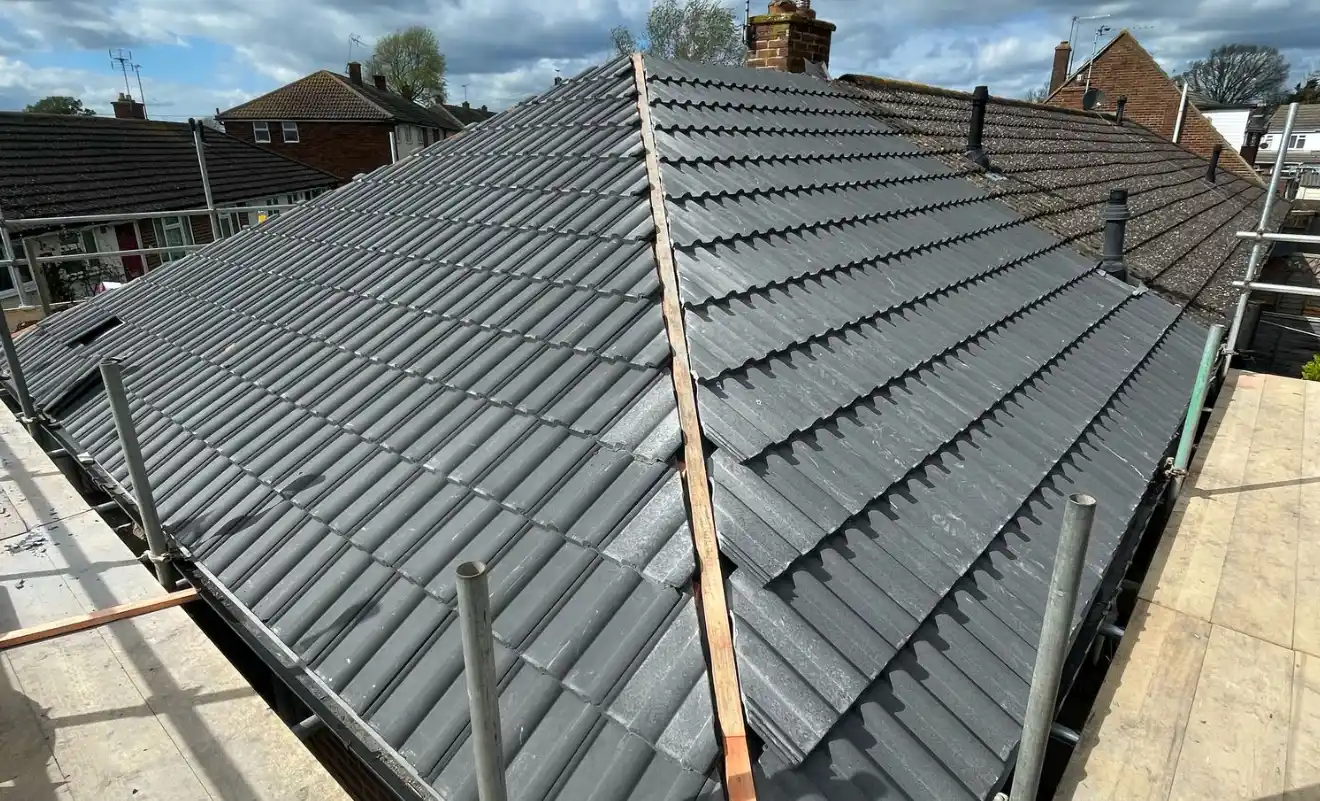
These figures are for a full strip and re-roof: scaffolding, new breathable felt, battens and tiles, not patch repairs. They assume a standard pitched roof being replaced like-for-like. If you are changing materials, adding insulation, or there is structural damage underneath, costs go up.
How roofers price the work
Most quotes come back as a cost per square metre. For a standard pitched roof in the South East, you're looking at £100 to £130 per m² for labour and materials combined.
Your roof area is roughly your home's footprint multiplied by 1.2 to 1.5, depending on the pitch. A semi-detached with a 60 m² footprint probably has around 75 to 85 m² of actual roof to cover.
| Roof area | Estimated cost (South East) |
|---|---|
| 40 – 50 m² | £4,500 – £6,500 |
| 60 – 80 m² | £7,000 – £10,000 |
| 90 – 120 m² | £10,000 – £15,000 |
| 120 m² and above | £14,000 – £20,000+ |
What drives the price up or down
Two houses on the same street can get very different quotes, and it is rarely because one roofer is trying it on. These are the things that genuinely move the number.
Roof size and shape
This is the big one after material. A simple gable roof on a straight house is the cheapest shape to work on. A hipped roof with multiple faces, valleys and ridges takes more labour and more materials, and generates more cutting waste. Dormers, skylights, chimneys and changes of level all add time.
Two houses can have identical floor areas and very different roof costs purely because of the design.
Access and scaffolding
You cannot safely re-roof a house without proper access, and scaffolding costs change depending on how many elevations need covering, the height of the property, whether a scaffold bridge is needed over a conservatory, extension or lower roof, and how long the scaffold has to stay up. A tight side return or a roof over a conservatory costs more than a straightforward front and back.
Condition of the roof structure
If the structure underneath is sound, the job is strip, check, re-felt, re-batten and retile. Costs rise when the roofer finds rotten rafters or trusses, sagging or damaged decking on flat sections, poor historic alterations that need correcting, or missing structural bracing. None of this can be seen until the tiles and felt are off, which is why a sensible contingency matters.
Insulation and ventilation
A modern re-roof is not just about keeping rain out. Building Regulations expect the roof to be upgraded where it is practical to do so, which can mean topping up loft insulation to the correct depth, adding ventilation at the eaves and ridge to prevent condensation, and fitting vent tiles for bathrooms, kitchens and extractor fans. It adds to the cost, but it protects the structure you have just paid for and can cut your heating bills.
Where you live
Roofing prices are not the same across the country. Busy areas and much of the South and South East carry higher labour rates. Rural and lower-cost areas can be cheaper, although travel and awkward access sometimes cancel that out. This is why an online average is a sanity check, not a budget.
What material are you replacing it with?
The material you choose has one of the biggest impacts on total cost. Here's how the main options compare:
Concrete tiles
The most common choice on UK homes. Concrete tiles cost £90 to £115 per m² installed. They last 30 to 50 years, come in plenty of colours and profiles, and are straightforward to source and fit. Moss can build up over time in damper areas, but that's manageable with periodic cleaning.
Natural slate
Slate costs more upfront at around £130 to £170 per m² installed, but it lasts well over 100 years if the work is done properly. It looks better than concrete on most properties and is often required in conservation areas. Heavier than other materials, so the roof structure needs to be sound.
Clay tiles
Clay sits between concrete and slate on price, coming in at around £110 to £150 per m² installed. They're common in the Chilterns, Cotswolds and parts of Surrey where the look fits the local architecture. Lifespan is 50 to 100 years.
Man-made slate
A mid-range option that gives the look of slate without natural slate prices. Worth asking about if you want the appearance of a slate roof on a budget, or if the existing structure would struggle with the weight of the real thing.
Metal roofing
Steel and aluminium roofing has become more popular, particularly on extensions and contemporary builds. Costs run £100 to £150 per m² installed. Low maintenance, lasts 40 to 70 years, and handles wind well.
| Roof type | Cost per m² installed (South East) |
|---|---|
| Standard concrete tiles | £90 – £110 |
| Natural slate | £120 – £160 |
| Clay tiles | £110 – £150 |
| Metal roofing | £100 – £150 |
| Flat roof (felt/EPDM) | £50 – £90 |
| Flat roof (fibreglass/GRP) | £70 – £100 |
You are not just paying for the tile. Each material has different labour time, fixings and detailing, so the price of the full system can vary far more than the headline material price suggests.
Flat roofs
Flat roof replacement is cheaper per square metre but the material choice matters a lot:
| Material | Cost per m² installed | Expected lifespan |
|---|---|---|
| Felt (3-layer) | £50 – £70 | 10 – 15 years |
| EPDM rubber | £65 – £85 | 25 – 35 years |
| Fibreglass (GRP) | £70 – £100 | 25 – 40 years |
As whole jobs rather than per square metre, a garage or small extension flat roof typically comes in at £1,500 to £4,000, and larger flat roof areas at £4,000 to £7,000.
If you have a flat roof, felt is the cheapest option but you will likely be replacing it again within 15 years. GRP or EPDM costs more initially but it is the better long-term decision for most homeowners.
The costs most quotes don't mention upfront
This is where people get caught out. A quote that looks reasonable can grow once the job starts. These aren't surprises a good roofer should spring on you, but they are things worth asking about before work begins.
Scaffolding: Almost every roof replacement needs it. Budget £800 to £1,500 for a standard semi-detached. Some contractors include this, many don't. Always check.
Stripping and disposal: Removing the old roof covering and taking the waste away costs £20 to £40 per m² depending on how many layers there are. For a 70 m² roof that's potentially £1,400 to £2,800 on top of the replacement cost.
Structural repairs: Once the old covering comes off, you might find rotten timbers, damaged rafters or failing decking underneath. This can't be priced until the roof is stripped. Set aside a contingency of £500 to £2,000 on older properties, just in case.
Fascias, soffits and guttering: Many homeowners replace these at the same time as the roof because the scaffolding is already up and it's cheaper than doing it separately later. A full uPVC fascia and soffit replacement on a semi-detached typically adds £1,500 to £3,000.
Insulation: If your loft insulation is inadequate or damaged, replacing it while the roof is open makes sense. Budget £300 to £800 depending on the area.
Chimney work: If the property has a chimney, get it inspected while roofers are already up there. Repointing or minor repairs typically cost £300 to £800. New lead flashing or capping an unused chimney is worth pricing at the same time.
Skips and waste: Stripping a roof produces a lot of waste and a larger job can need several skips. On a standard semi-detached, waste removal and skip hire usually falls between £300 and £600.
Roof windows: If you have old Velux or similar units, replacing them while the roof is open is far cheaper than doing it as a separate job later.
Dry ridge and verge systems: Older roofs bed the ridge and verge tiles in mortar, which cracks and lets water in as it ages. Most roofers will recommend replacing failing mortar beds with a mechanically fixed dry ridge and verge system as part of the re-roof.
Done properly, a re-roof is a full system upgrade from the rafters outwards, not just new tiles laid on top.
What if there's spray foam insulation in the roof?
This is worth a separate mention because it catches a lot of homeowners off guard. If someone previously had spray foam insulation applied in your roof space, it needs to come out before any roofing work can be done. Most mortgage lenders also won't approve a property sale until it's removed.
Spray foam removal costs between £1,500 and £4,000 for an average home and adds time to the job. If you're not sure whether you have it, it's worth checking before you get quotes, as it will change the scope of the work significantly.
Alliance Roofing carries out spray foam removal across all our service areas. See our spray foam removal service for more detail.
| Task | Typical cost |
|---|---|
| Single layer removal | £20 – £25 per m² |
| Double layer removal | £30 – £40 per m² |
| Waste disposal | £300 – £600 |
How costs vary by region
Where the property sits makes a real difference, mostly through labour and disposal rates. Prices vary across the areas we cover, so here is a rough guide for a standard semi-detached house:
| Location | Estimated cost (semi-detached) |
|---|---|
| Central London | £8,000 – £13,000 |
| Outer London (Harrow, Ealing, Wimbledon) | £7,000 – £11,000 |
| Surrey (Guildford, Woking, Weybridge) | £6,500 – £10,000 |
| Berkshire (Reading, Windsor, Bracknell) | £6,000 – £9,000 |
| Buckinghamshire (High Wycombe, Chesham, Amersham) | £5,500 – £8,500 |
| Oxfordshire (Oxford, Bicester, Didcot) | £5,500 – £8,000 |
| Hampshire (Winchester, Basingstoke, Alton) | £5,000 – £8,000 |
A closer look at Buckinghamshire
Buckinghamshire is our home county, so this is the area we can be most specific about. A full roof replacement here usually costs somewhere between £5,000 and £15,000. Smaller roofs sit at the lower end, while larger homes or premium materials such as slate push the price much higher. For a typical 3-bedroom semi-detached house, a new concrete tile roof often lands around £5,000 to £7,500, assuming the roof structure underneath is still in good condition. Our roofers in Buckinghamshire quote every one of these jobs after a proper inspection, not off a price list.
Here is roughly how that breaks down on a standard concrete tile semi:
| Item | Typical cost |
|---|---|
| Materials (tiles, battens, membrane) | £2,000 – £3,000 |
| Labour | £1,500 – £2,500 |
| Scaffolding | £800 – £1,500 |
| Waste removal and skip hire | £300 – £600 |
| Estimated total | £5,000 – £7,500 |
Slate changes the picture. A slate roof replacement on a semi-detached property typically costs £8,000 to £14,000, and on a large detached home £14,000 to £20,000 or more. Slate costs more up front but can last well over 100 years when it is installed properly.
The county has a wide mix of housing, and the type of property tends to predict the job. The 1930s semis found across Buckinghamshire usually need tile replacement and updated underlay. Older village properties often carry slate or clay and sometimes need specialist work to match the existing roof. Newer detached homes tend to have larger, more complex roof designs, which pushes up both labour and scaffolding.
How long does a roof replacement take?
| Property type | Typical duration |
|---|---|
| Terraced house | 2 – 3 days |
| Semi-detached | 3 – 5 days |
| Detached house | 5 – 8 days |
| Large or complex roof | 8 – 14 days |
Bad weather, scaffolding delays, or structural issues found during stripping can all extend the timeline.
Do you need planning permission for a new roof?
In most cases planning permission is not required, provided the new roof matches the existing design and materials. Permission may be needed if the property is listed, if the house sits in a conservation area, or if the roof design is being significantly changed. Building Regulations can still apply when large areas of roof are replaced, even where planning permission is not needed, so ask your roofer who is handling Building Control notification before work starts.
Should you repair or replace?
Not every roof problem needs a full replacement. If the damage is isolated to a handful of broken slates, a section of failed flashing or a small flat roof section, repairs are usually the right call.
The point where replacement makes more sense is when more than 25 to 30 percent of the roof covering is failing, when the underlying timbers are compromised, or when the roof is old enough that patching it just delays the inevitable and costs you more in the long run.
The clearest signs you are looking at a full replacement rather than a repair:
- Large areas of slipped, broken or missing tiles
- Felt perished behind the tiles, with visible sagging between the rafters
- Repeated leaks in different parts of the roof
- Rotten or damaged underlay and battens across big sections
- A roof that is 20 to 30 years old or more and has already had multiple patch repairs
Sometimes the answer sits in between and only one elevation or one section needs stripping and re-covering. A good roofer will tell you honestly which one applies to your situation. If the first quote you get goes straight to full replacement without inspecting the roof properly, get a second opinion. If you are not sure yet, our roof repairs service can assess whether a repair will do.
When to call a roofer straight away
Some jobs around a house can wait. Roof problems usually cannot, because water always finds the cheapest path and that is normally through your insulation, plasterboard and wiring. Get someone out promptly if you notice water marks on ceilings, damp smells in the loft, tiles on the ground after high wind, pieces of mortar, slate or ridge tile in the garden, or a visible sag in the roof line when you look at the house from the street.
What to look for when getting quotes
Three quotes is the standard advice and it's right. But knowing how to compare them matters more than the number of quotes you collect.
Things to check before hiring anyone:
- Public liability insurance: ask to see the certificate, not just their word for it
- A written, itemised quote that separates materials, labour, scaffolding and disposal
- A workmanship guarantee of 10 years minimum from a reputable contractor
- NFRC membership or equivalent trade body registration
- References or examples of recent work in your area
A quote worth comparing should itemise the lot, not give you one number at the bottom of a page. Look for:
- Strip and disposal of the old roof covering
- New felt and battens
- Tile type and quantity
- Fixings and any dry ridge or verge systems
- Insulation and ventilation upgrades
- Fascias, soffits and guttering if they are being done
- Scaffolding, including how long it stays up
- Allowances for chimney or lead work
- VAT and payment terms
Ask what guarantee sits on the materials, what guarantee sits on the workmanship, and who handles Building Control notification if it is required. Then keep a contingency of 10 to 15 percent aside. Roofs hide surprises, and a contingency is the difference between an inconvenience and a problem.
Walk away from anyone who wants a large cash deposit upfront, will not give you a written quote, or tells you the roof needs replacing when they have not looked at it properly.
Common questions
Does home insurance cover roof replacement?
Buildings insurance covers sudden damage such as storms, falling trees or fire. It doesn't cover wear and tear or a roof that's simply come to the end of its life. Check your policy before assuming you're covered.
When is the cheapest time to get a roof replaced?
Late autumn and early spring tend to be quieter for roofing companies. You're more likely to get availability and potentially better pricing than in peak summer when every roofer is booked solid.
How long will a new roof last?
Concrete tiles: 30 to 50 years. Clay tiles: 50 to 100 years. Natural slate: 100 years or more. Metal: 40 to 70 years. Felt flat roofs: 10 to 15 years. GRP or EPDM flat roofs: 25 to 40 years.
Is a roof replacement worth it before selling?
Usually yes, if the roof is visibly failing. Buyers and surveyors will flag it, lenders may refuse to lend against it, and you'll lose more on the sale price than you'd spend on the replacement.
Get a free quote from Alliance Roofing
Alliance Roofing covers London, Surrey, Berkshire, Buckinghamshire, Oxfordshire and Hampshire. We provide free, written quotes with a full breakdown of costs with no vague estimates and no hidden extras.
If you'd like us to take a look and tell you honestly what your roof needs, get in touch and we'll arrange a convenient time to visit.