
Most flat roofs in the UK last 15–40+ years depending on the material, flat roof installation quality, and maintenance. Felt usually lasts 15–25 years, GRP 20–30, EPDM 25–40, and PVC single-ply 30–40+. Drainage and detailing decide whether you get the lifespan you paid for.
Key takeaways
- UK flat roofs typically last 15 to 40+ years depending on the material chosen.
- Felt lasts 15-25 years, GRP 20-30, EPDM 25-40 and PVC single-ply 30-40+ years.
- Installation quality, drainage and detailing matter as much as the material itself.
- A simple maintenance routine, clearing outlets and checking details, adds years to a roof's life.
If you are paying for a flat roof, you want a straight answer on lifespan, not vague “it depends” fluff.
A flat roof in the UK typically lasts 15 to 40+ years, depending on the system you choose, how well it’s installed, and how well it’s looked after. Cheap systems fail early. Good systems last, especially when drainage is right and maintenance is not ignored.
Below is what you can realistically expect from the main flat roofing options in the UK, plus how to spot when yours is nearing the end.
How Durable Are Flat Roofs?
A well-built flat roof is durable, waterproof and perfectly suited to UK weather. The problem is not that flat roofs do not work. The problem is that flat roofs punish bad workmanship.
On a pitched roof, gravity helps you out. On a flat roof, a small mistake in the falls, seams, outlets or detailing can sit there quietly for months, then show up as a leak at the worst possible time.
Done right, flat roofs are strong and long-lasting. Done cheaply, they become a repeat repair bill.
What Decides How Long Your Flat Roof Lasts
Two roofs the same age, built from the same material, can be in completely different condition. These are the factors that separate them.
Installation quality
This is the big one. The best materials in the world will fail if:
- the falls are wrong
- outlets are poorly placed
- edges are bodged
- seams are rushed
- flashing details are sloppy
If you want lifespan, you are paying for workmanship, not just materials.
Location and surroundings
Where the roof sits matters more than people think.
- Roofs under trees collect debris, block outlets and end up holding standing water.
- Roofs near chimneys or parapet walls have more joints and edge details, which are the usual failure points.
- Roofs in exposed, windy positions put far more stress on perimeters and fixings.
Ventilation and condensation
A lot of what gets reported as a roof leak is actually a moisture problem caused by ventilation and insulation.
Warm, humid air from the house rises, hits a cold deck and condenses. That moisture mimics a leak and rots timbers over time. If you have recurring damp with no clear entry point, you need someone who can tell the difference between water ingress and condensation before anyone starts pulling the roof apart.
Foot traffic and access
If people walk on the roof, it needs protection built in. Without it you get punctures and surface wear. This is common on roofs with satellite dishes, solar access, roof hatches or plant equipment, and it is one of the quickest ways to lose years off a membrane that was otherwise fine.
Age and old repairs
A flat roof does not suddenly fail on its 20th birthday, but materials do age. Adhesives weaken, joints become brittle, small cracks open and close with temperature changes, and previous patch repairs start to lift around the edges.
The older the roof, the more likely you are dealing with several problems at once rather than one.
Some Notes On Maintenance
Flat roofs do not usually “suddenly fail”. They slowly get worse, and most owners only notice once water is already inside.
A simple maintenance routine adds years to a roof’s life:
- Keep outlets and gutters clear. Standing water is a roof killer.
- Remove moss, silt, and leaves. Debris holds moisture, which speeds up wear.
- Check details around upstands, skylights, pipe penetrations, and edges. Most leaks start here.
- Avoid unnecessary foot traffic. Flat roofs are not patios unless designed as one.
- Get an inspection after storms. Wind-lift and torn edges are common in the UK.
If you do one thing, do this: make sure water can leave the roof quickly. If it ponds, you are shortening the lifespan, no matter what the membrane is.
What About The Manufacturer’s Guarantee?
Manufacturer warranties are useful, but people misunderstand them.
- Most warranties cover materials, not the full cost of putting things right.
- Some warranties only apply if the roof is installed by an approved installer and the system is installed exactly to spec.
- Many require proof of maintenance or periodic inspections.
- Warranties often exclude damage caused by standing water, foot traffic, or third-party work (like a random contractor drilling through the roof for cables).
So yes, look at the warranty, but treat it as a back-up, not your whole plan.
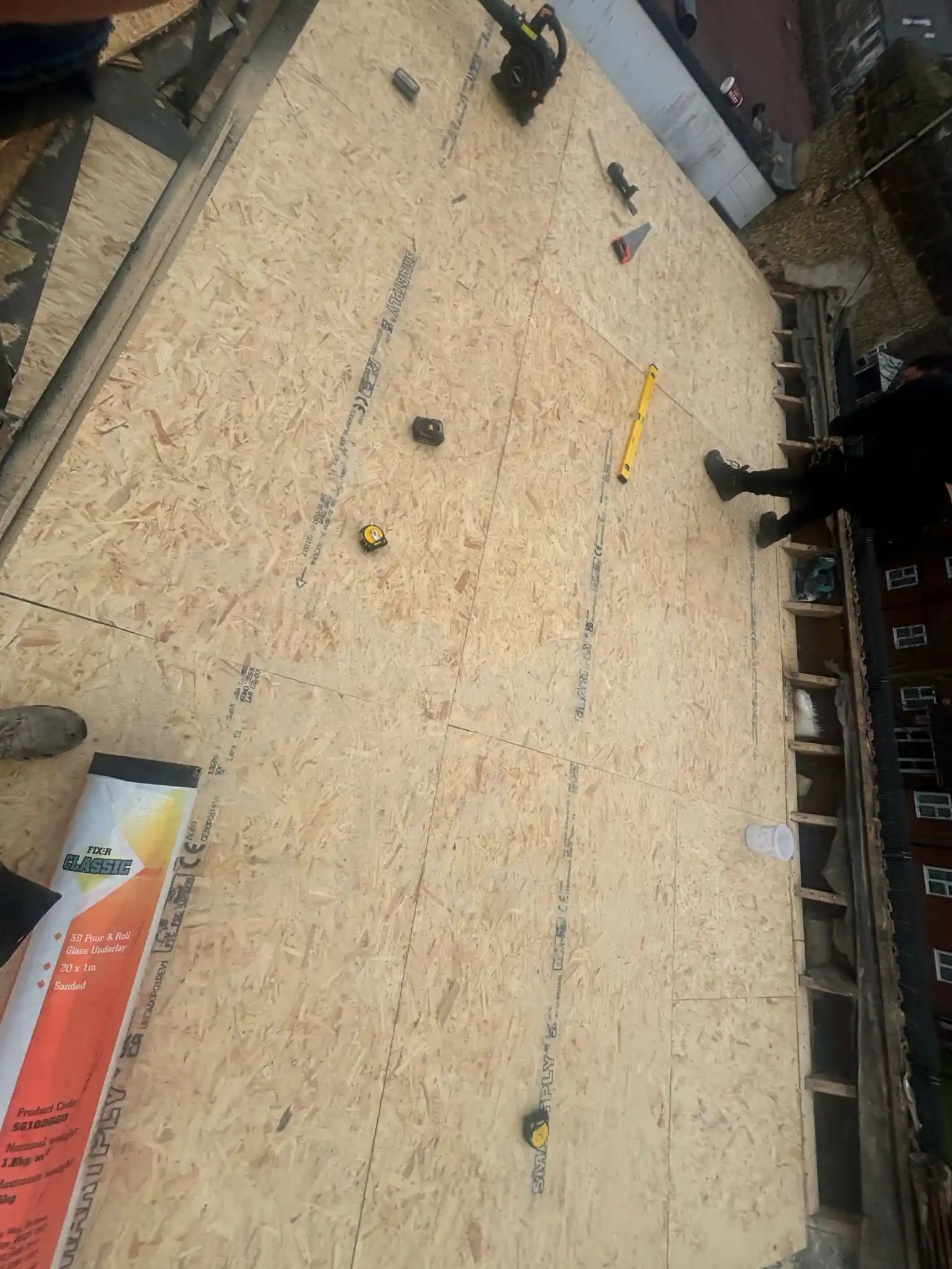
How Long Does A Felt Flat Roof Last?
Typical UK lifespan: 15 to 25 years (modern high-performance felt)
Older or low-grade felt systems can be closer to 15 to 25 years.
Felt is still common in the UK because it is cost-effective and works well when installed properly.
What makes felt fail early:
- Poor detailing at edges and outlets
- Weak overlaps and joints
- Heat damage during installation
- Persistent ponding water
- Patch repairs stacked on top of each other instead of fixing the real cause
When felt is a solid choice:
- You want a proven system at a sensible price
- The roof has simple geometry and good drainage
- It’s installed as a proper multi-layer system, not a rushed job
How Long Does A Glass Reinforced Polymer Fibreglass (GRP) Flat Roof Last?
Typical UK lifespan: 20 to 30 years
GRP can last well, but it is less forgiving if the install is sloppy.
GRP is popular on smaller domestic roofs like extensions and garages. Done right, it’s tough. Done badly, it cracks and you get a leak that keeps coming back.
What makes GRP fail early:
- Movement in the deck or structure, GRP does not like flex
- Poor preparation, moisture in the deck, or rushed curing
- Weak detailing around trims and upstands
- Hairline cracks that get ignored until they become real problems
When GRP is a good choice:
- Smaller roofs with limited movement
- Install conditions are right, dry deck, correct temperature range
- You want a hard surface finish
How Long Does An EPDM Flat Roof Last?
Typical UK lifespan: 25 to 40 years
You will see bigger claims online. Real-world lifespan depends heavily on workmanship and detailing.
EPDM is a rubber membrane. It can last a long time and it handles UK temperature swings well. The weak point is usually not the sheet itself, it’s the details: edges, outlets, and any seams.
What makes EPDM fail early:
- Bad bonding or incorrect adhesive use
- Poor edge restraint in windy areas
- Weak detailing around penetrations
- Damage from foot traffic or sharp debris
When EPDM makes sense:
- Large roof areas where fewer joins are a benefit
- You want a system with a long track record
- You are prioritising longevity over a “pretty” finish
How Long Does A Vanguard PVC Single-Ply Flat Roof Last?
Typical UK lifespan: 30 to 40+ years
Single-ply systems are often the longest-lasting option when installed correctly.
PVC single-ply is commonly used on larger roofs and commercial buildings because seams are heat-welded, it can be detailed cleanly, and it performs well long term.
Why it lasts:
- Welded seams can be extremely durable
- The membrane is stable and handles movement well
- It copes with standing water better than many systems, though drainage still matters
- Maintenance is usually simpler
Trade-offs:
- Higher upfront cost than basic felt
- Installation must be done properly by trained installers
If you want the best shot at a flat roof that is still doing its job decades from now, this category is usually where you end up.
How Long Does A Liquid-Applied Flat Roof Last?
Typical UK lifespan: 20 to 30+ years
Liquid systems earn their place where a sheet system struggles.
They are applied like a thick coating and cure into a seamless waterproof layer, which makes them useful on roofs with awkward shapes, lots of upstands, or tricky details around pipes and rooflights. Some are reinforced with fabric for extra strength.
What makes liquid systems fail early:
- Poor surface preparation, which is the single biggest factor
- A weak or damp substrate underneath
- Cheap coatings applied too thinly
- Curing rushed in the wrong weather or temperature
When a liquid system makes sense:
- Complicated roofs where a sheet membrane means dozens of cuts and joins
- Overlays on a roof that is tired but structurally sound
- Localised areas and detailing work alongside another system
If the substrate is poor, the system will fail early. That is not a fault of the product, it is a fault of the prep.
The Long and Short Of Flat Roofs
Here’s the honest summary:
- Felt: 15–25 years if it’s modern, multi-layer, and installed well
- GRP: 20–30 years, good on smaller roofs, less forgiving of movement
- Liquid-applied: 20–30+ years, useful on awkward shapes, prep decides everything
- EPDM: 25–40 years, great membrane, details matter
- PVC single-ply: 30–40+ years, often the best long-term performer
A flat roof’s lifespan is not just the material. It’s mostly:
- installation quality, 2) drainage design, 3) maintenance.
If any of those are poor, you can turn a “30-year roof” into a “10-year headache”.
What Shortens A Flat Roof’s Life In The UK?
A few UK-specific realities:
- Freeze-thaw cycles open up small weaknesses in laps, edges, and trims
- Storm wind uplift attacks perimeters and weak fixings
- Ponding water is common on older roofs with sagging decks
- Moss and debris trap moisture and hide damage
- Trades drilling through the roof for vents, cables, solar, HVAC, this happens all the time
If your roof is on a building with plant equipment, regular access, or lots of penetrations, it needs a system designed for that, not a basic domestic spec.
Signs Your Flat Roof Is Nearing The End
You do not need to guess. Watch for:
- Recurring leaks in different spots
- Blisters, splits, or cracking on the surface
- Deteriorated edge trims or lifting at the perimeter
- Soft spots underfoot
- Water staining internally that keeps returning after “repairs”
- Ponding that is getting worse year by year
The sign people miss: heat and damp inside
Not every warning sign is on the roof. If your heating bills have jumped with no obvious explanation, parts of the property feel cold or damp, or you have ongoing condensation near the roof line, the insulation in the roof build-up may be wet or failing. Once insulation is saturated it has to come out and be replaced as part of a new build-up, which is what turns a repair conversation into a replacement one.
If you are paying for repeated patch repairs, you are probably wasting money. It is worth weighing that ongoing spend against a fresh install using our roofing cost guide before you decide.
When To Replace Rather Than Repair
Repair after repair eventually stops making sense. The trick is knowing when you have crossed that line, so you avoid both replacing a sound roof too early and paying for water damage you could have prevented.
How often flat roofs actually get replaced
Most flat roofs need major refurbishment or full replacement somewhere between 15 and 30 years. A lot get replaced around the 15 to 25 year mark, and usually not because the material itself was useless:
- drainage has been poor for years
- maintenance has been ignored
- the original installation was weak
- repairs have stacked up until it is a patchwork roof
Condition matters more than the date on the calendar. Do not wait for a particular birthday if the roof is already leaking, sagging or breaking down, and do not replace a roof that is performing just because it has hit a number.
When a repair is still the right call
Repairs make sense when:
- the roof is well within the normal lifespan for its material
- the damage is local, for example a single split or puncture
- the deck is firm with no sagging
- you have not been chasing leaks for years
In those cases a targeted roof repair or partial overlay buys you more safe years before a full replacement.
When replacement is the smarter move
Replacement is usually the better decision when:
- the roof is at or beyond the typical lifespan for its system
- there are multiple leaks in different areas
- there is ponding water, dips or soft spots in the deck
- the roof has a long history of repairs
- you are planning other major work such as an extension or loft conversion
At that point, constant repairs usually cost more over time than a new, warrantied system. If you are weighing up which system to fit next, our guide to the best material for a flat roof compares EPDM, GRP, felt, single-ply and liquid systems side by side.
Can refurbishment buy more time?
Sometimes, but do not get excited too early. Refurbishment can work if the deck is still solid, the existing build-up is stable, the problems are surface-level and localised, and drainage can be improved. If the deck is damaged or rotten, replacement is the smarter move.
A proper inspection is what tells you whether you are buying extra years or throwing good money after bad.
What Affects The Cost Of A Flat Roof Replacement
Replacement costs move with:
- roof size
- material choice
- how easy the roof is to access
- whether the deck and insulation also need replacing
- scaffolding and safety requirements
Smaller residential flat roof replacements often run into a few thousand pounds. Larger or more complex projects cost more, and the system you choose has a real bearing on the price. A proper on-site survey is the only honest way to give an accurate figure.
What matters is value rather than the lowest number. A well designed, correctly installed roof should last many years. A cheap, rushed job puts you back in the same position much sooner.
Do You Need A Roof Survey?
If your roof is older, has recurring issues, or you are budgeting for works, a survey is worth the money. You want to know:
- what system you actually have
- whether the deck is sound
- where water is sitting
- what is failing first, and why
Between surveys, keep it simple. Do your own basic checks twice a year and get a professional inspection every year or two, or sooner if something changes. Be careful with DIY fixes as well: the wrong coating or sealant is not compatible with every membrane, and a quick fix from the wrong tube can cause more harm than the original fault.
Guessing costs more than inspecting.
If you want a clear answer on how much life your flat roof has left, book a proper inspection and get it assessed before the next leak does the talking. Our flat roof installation and repair team works with homeowners across Berkshire and Buckinghamshire and will give you a straight answer on repair versus replacement.
Call us today to book a roof check and get a straight quote.