
Most flat roofs in Hertfordshire cost £1,200–£4,500+ depending on size, access, and the flat roof system you choose. For most domestic extensions, the best-performing options are usually high-performance felt, EPDM rubber, GRP fibreglass, or liquid waterproofing. A straightforward replacement often takes 1–3 days, but decking repairs, insulation upgrades, or awkward access can extend the timeline. If you’re seeing bubbling, cracks, persistent ponding, or recurring leaks, you’re usually past the point of “just patch it”.
Key takeaways
- Most flat roofs in Hertfordshire cost £1,200 to £4,500+, driven by size, access and the system chosen.
- High-performance felt, EPDM rubber, GRP fibreglass and liquid waterproofing suit most domestic extensions.
- A straightforward replacement usually takes 1 to 3 days, longer if decking or insulation needs work.
- Bubbling, cracks, persistent ponding or recurring leaks usually mean replacement beats another patch.
Flat roofs are everywhere across Hertfordshire, from rear extensions in Watford and Hemel Hempstead, to garages in St Albans, to dormers and bay roofs in towns like Hitchin and Harpenden. Our roofers in Hertfordshire see all of them. They can be a solid, long-term solution, but only if you choose the right system and it’s installed properly.
This guide breaks down what flat roofing typically costs in Hertfordshire, which materials make sense for different properties, how long the work usually takes, and what you should expect from a proper job, not a quick patch that fails a year later.
Why flat roofs are so common in Hertfordshire
Hertfordshire has a mix of older housing stock and constant home improvement work. Flat roofs show up again and again because they suit:
- Single-storey extensions (kitchen diners, utility rooms, garden rooms)
- Garages and car ports
- Dormers and small roof areas
- Porches and bay windows
- Apartment blocks and commercial units
They also make sense when planning constraints or neighbouring properties make a pitched roof difficult.
The downside is simple, flat roofs don’t forgive poor workmanship. If the falls are wrong, the outlets are badly positioned, or the detailing is sloppy around edges and upstands, you’ll see problems fast.
A flat roof is never actually flat
Despite the name, a flat roof is built with a slight fall so rainwater drains away rather than sitting on the surface. That fall is the whole design. When it is wrong, or when drainage fails, water starts to pool, and that is where most flat roof problems begin.
It matters because the fall dictates everything else. Get it right and a modern system can last decades. Get it wrong and no amount of expensive membrane saves the roof, because the water never leaves.
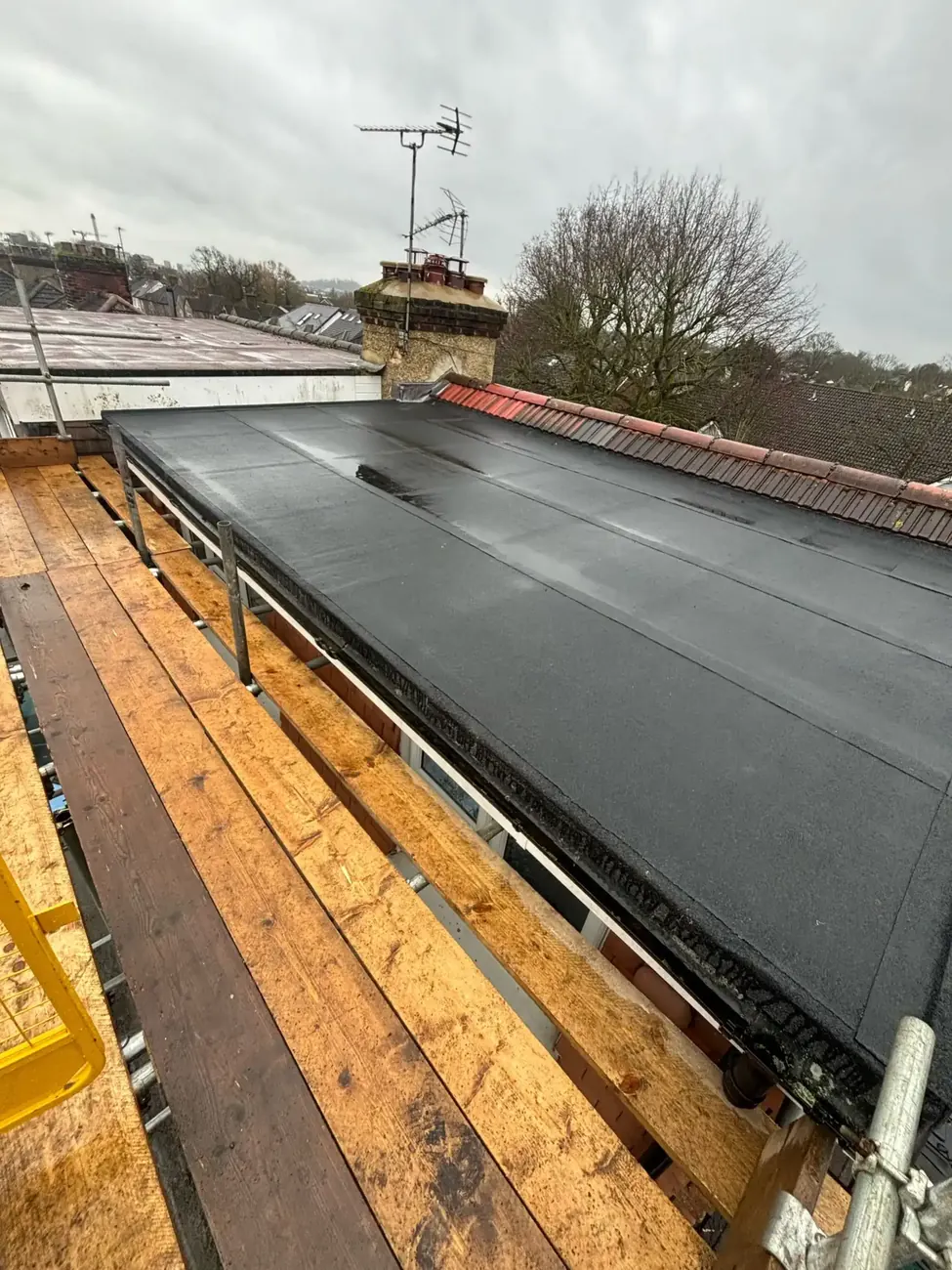
How much does flat roofing cost in Hertfordshire?
There’s no single number that fits everyone, but you can use these as sensible ranges for typical domestic jobs.
Typical cost ranges
- Small area repairs (localised patching): £150–£450
- Garage flat roof replacement: £900–£2,500
- Extension flat roof replacement (medium size): £1,800–£4,500
- Balcony / terrace waterproofing: £1,500–£6,000+
- Full strip and rebuild with insulation upgrades: £2,500–£7,500+
Those ranges move depending on the factors below.
What drives the price up (or down)
1) Roof size and complexity
A simple rectangle is cheaper than a roof full of corners, skylights, pipes, parapets, or multiple levels.
2) Access
If a roof can’t be safely reached without scaffolding, costs jump. Hertfordshire has plenty of tight driveways, terraced streets, and extensions built right up to boundaries.
3) The condition of the decking underneath
If the timber deck is soft, rotten, or sagging, you’re not just “re-covering”. You’re rebuilding sections properly.
4) Insulation and ventilation
Upgrading insulation can be the smartest long-term move, but it adds materials and labour. A warm roof build-up generally costs more than a basic recover.
5) Drainage and outlets
Fixing ponding properly often means improving falls, outlets, or gutters. If water can’t get off the roof, the system gets punished all year.
The main flat roofing materials, and which one to choose
If someone tries to sell you “the best” flat roof without asking how you use the roof and what the structure is like, ignore them. The right material depends on the property and the details.
High-performance felt
Modern felt systems are not the old-school stuff that failed every ten years. Installed properly, they’re a strong option for domestic roofs, especially extensions and garages.
Best for: Extensions, garages, dormers, general domestic work
Why people pick it: Cost-effective, tough, widely used, easy to repair
Watch-outs: Detailing matters, outlets and upstands must be done properly
EPDM rubber
EPDM is a single-piece rubber membrane, commonly used on domestic extensions and garages.
Best for: Straightforward roofs with fewer penetrations
Why people pick it: Clean finish, fewer seams, good longevity
Watch-outs: Poor edge detailing is where problems start, and some “cheap installs” cut corners on trims and bonding
GRP fibreglass
GRP is a hard, seamless system, usually finished with a topcoat.
Best for: Smaller domestic roofs, garages, dormers, roofs with neat edges
Why people pick it: Seamless, tidy finish, good for more “designed” builds
Watch-outs: Can crack if the deck moves or if detailing is rushed, it needs the correct build-up underneath
Liquid waterproofing
Liquid systems are often used where a roof has awkward details, multiple penetrations, or where an overlay is possible.
Best for: Complex roofs, balconies, walkways, refurbishments
Why people pick it: Great for tricky detailing, seamless once cured
Watch-outs: Prep is everything, poor preparation means poor adhesion
Single-ply membranes (PVC/TPO)
These are more common on larger commercial roofs, blocks, and public buildings.
Best for: Larger roof areas, commercial properties, property portfolios
Why people pick it: Lightweight, strong, good on larger spans
Watch-outs: Needs correct welding and proper detailing, not a “small-job” material unless the contractor specialises in it
How long does flat roofing take in Hertfordshire?
Most domestic flat roofing work is quicker than people expect, until you hit structural issues or access limitations.
Typical timelines
- Minor repair: Same day to 1 day
- Garage replacement: 1–2 days
- Extension replacement: 1–3 days
- Rebuild with deck repairs + insulation upgrade: 2–5 days
- Balcony / terrace waterproofing: 2–6 days (depends on size and detailing)
What can delay the job
- Bad weather (some systems are more weather-sensitive)
- Hidden rot in the deck
- Waiting for scaffolding
- Unexpected drainage issues
- Extra detailing around skylights, lanterns, pipes, or parapet walls
If a roofer promises a complex replacement in half a day, they’re either lying or they’re doing a bodge.
What a proper flat roof job should include
If you want the roof to last, the basics have to be right. Not “mostly right”, actually right.
1) Correct falls and drainage
Flat roofs shouldn’t hold water for days. A small amount of temporary standing water after heavy rain can happen, but persistent ponding is a red flag.
2) Sound deck
If the deck is soft, swollen, or sagging, it must be repaired or replaced. Covering rotten timber is throwing money away.
3) Clean, tight detailing
Edges, corners, outlets, and upstands are where roofs fail. Good contractors obsess over the boring details because that’s what keeps your ceiling dry.
4) Proper protection where needed
If the roof is used for access (solar, HVAC, regular maintenance), it needs extra protection. Foot traffic destroys surfaces when it isn’t planned for.
5) Clear finish and tidy handover
You should be shown what was done, what materials were used, and what maintenance to do going forward. If you get a rushed handshake and no explanation, expect problems.
What fails first on a flat roof
Most flat roof failures don’t announce themselves. They start quietly, often months or years before anything shows on a ceiling.
Ponding water
Water that sits on a flat roof for more than 48 hours after rain slowly weakens seams and joints. Given time, it finds a way in.
Cracks and splits in the membrane
Older felt roofs and poorly installed membranes crack under UV exposure, temperature swings, and general wear.
Failed joints, edges and upstands
Edges, trims and upstands are the weak points. Small gaps here cause leaks that travel through the build-up before showing up inside, often in a completely different spot from the actual damage.
Blocked outlets and gutters
Leaves and debris stop water draining properly, which leaves the roof surface under pressure every time it rains.
Blistering and trapped moisture
Blisters usually mean moisture is trapped under the covering, commonly from poor ventilation, low-quality materials, or a rushed installation over a damp deck.
Poor installation
Incorrect falls, rushed detailing, or incompatible materials cause repeat failures. These rarely show up until heavy rain arrives.
What you can safely check before calling a flat roofer
You don’t need to climb onto the roof to gather useful information.
- Check ceilings below the flat roof for staining or bubbling
- Note whether leaks appear only after heavy or prolonged rain
- Look for overflowing gutters or downpipes during rainfall
- Check inside the roof void, if it’s accessible, for damp insulation or water trails
- Take photos of visible issues from the ground
That helps a roofer diagnose the problem faster and more accurately, and it usually shortens the visit.
Signs you might need repairs vs a replacement
Not every issue needs a full replacement, but there’s a point where repairs become a money pit.
Repairs might be enough if:
- The leak is localised and the roof is otherwise in good condition
- There’s a single damaged area from impact or weather
- The system is relatively modern and the failure point is clear
Replacement is usually smarter if:
- You’ve had recurring leaks over multiple seasons
- The surface is cracking, blistering, or pulling away
- There are widespread soft spots or sagging
- Water is ponding badly and drainage is wrong
- The insulation underneath is saturated
- Multiple patch repairs have already failed
- The roof is nearing the end of its realistic service life
A decent roofer will tell you when repairs are a sensible short-term solution, and when you’re just delaying the inevitable.
Maintenance and inspections that prevent the big bills
Flat roofs reward a small amount of attention. A lot of the emergency call-outs we attend would have been a cheap repair a year earlier.
Sensible maintenance looks like:
- An annual inspection
- A quick check after storms
- Clearing debris from outlets and gutters
- Watching for water that pools and doesn’t clear
Book an inspection sooner rather than later if:
- You see staining or damp patches on the ceiling below the roof
- Water sits on the roof long after the rain stops
- The roof has been patched more than once
- You’re planning to sell or renovate the property
- The roof is approaching the end of its expected lifespan
Early inspections almost always cost less than emergency repairs.
What to expect when you request a quote
If you want a quote that’s worth anything, you should expect questions like:
- How old is the roof?
- What’s underneath it (deck type, insulation)?
- Has it leaked before, and where?
- Are there skylights, pipes, or parapet walls?
- How is the roof drained (outlets, gutters)?
- What access is available for safe working?
If the quote is based on a two-minute glance from the ground, treat it as a guess, because that’s what it is.
If you’re in Hertfordshire and you’re dealing with a flat roof leak, ponding water, or an ageing extension roof, get it checked properly before it turns into ceiling damage and mould. Book a roof inspection and get a clear plan of action, whether that’s a targeted repair or a full replacement done once and done right.